 computertipsguru@gmail.com
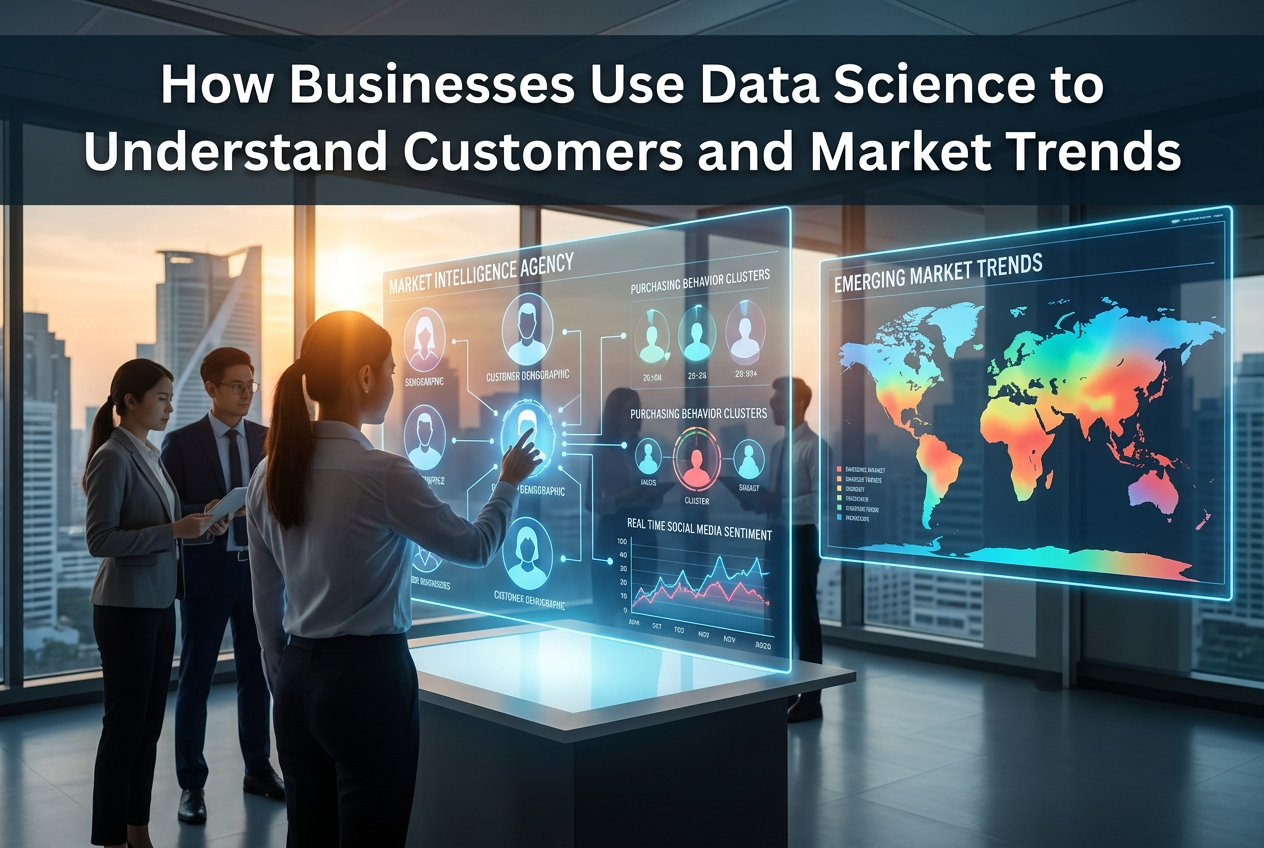
Understanding customers is one of the most important challenges businesses face. Customer preferences change, competitors introduce new products and market conditions shift over time. Organisations that rely only on assumptions may miss important signals hidden in their business data.
Data science provides methods for studying customer behaviour, identifying market trends and supporting better decisions. By combining data collection, statistical analysis, visualisation and predictive modelling, businesses can develop a clearer understanding of their markets.
What Are Data Science Applications in Business?
Related voice: Sales Funnel Explained: How to Turn Leads Into Customers · Content Marketing Strategy for Small Businesses in 2026 · SEO vs Paid Ads: Which Digital Marketing Strategy Works Better?
Data science applications involve using analytical techniques and computational tools to solve practical problems. These applications range from analysing sales reports to developing machine learning models that estimate demand or classify customer feedback.
The appropriate method depends on the question a business wants to answer. A simple chart may be sufficient to identify a sales decline, while a more complex model may be useful when a company needs to analyse many variables simultaneously.
The objective is not to use the most advanced technology available. It is to produce reliable insights that support a specific decision.
Related voice: Corporate Social Responsibility: Why It Matters for Modern Businesses · How Small Agencies Can Scale SEO Without Losing Quality
1. Identifying Customer Preferences
Businesses collect information through purchases, website interactions, surveys, service requests and customer feedback. Analysing these sources can reveal what customers value and where they experience difficulties.
For example, an online store may find that customers frequently search for a product category but leave without completing a purchase. By investigating product availability, prices, delivery information and the checkout process, the business can identify possible reasons for the behaviour.
Customer segmentation can provide another useful perspective. A business may group customers according to purchasing frequency, product interests or engagement patterns. These groups can help teams tailor communication and improve service, provided the analysis respects privacy and avoids unfair assumptions.
2. Understanding Market Trends
Market trends describe changes in demand, customer interests, pricing, competition or broader industry behaviour. Data science can help businesses identify patterns by examining sales records, search trends, market reports and other relevant sources.
Suppose a company notices growing demand for a particular product. It could compare performance across locations, customer groups and time periods to determine whether the increase is widespread or concentrated in a particular segment.
Historical information can help distinguish seasonal fluctuations from longer-term changes. However, past trends do not always predict future demand. New competitors, economic shifts and changes in customer preferences may alter the situation.
Businesses should combine quantitative analysis with industry knowledge and ongoing market research.
3. Improving Customer Retention
Attracting new customers can require significant time and investment. Retaining existing customers is therefore an important business objective.
Data science can help identify patterns associated with repeat purchases, customer engagement or service cancellations. For example, a subscription business might analyse usage frequency, unresolved support issues and renewal history to understand which factors are associated with cancellations.
A predictive model may help prioritise accounts that need attention, but it should not be treated as a definitive judgement about an individual. The business must evaluate the model’s accuracy and determine whether the resulting actions genuinely improve customer experience.
4. Supporting Product Development
Customer feedback can help companies decide which features to improve, which problems to address and where new opportunities may exist.
Text analytics can organise large volumes of comments into recurring themes. A software company, for example, might discover that users repeatedly report difficulty navigating a particular feature. Product teams can investigate the issue and compare feedback with usage data before deciding on a change.
Businesses can also analyse product returns, warranty claims and support requests to identify possible quality issues.
Data provides evidence for product decisions, but it should not replace direct customer research. Interviews, usability testing and feedback from frontline teams can reveal context that numerical patterns alone may miss.
5. Using Visualisation to Communicate Insights
Data analysis is useful only when decision-makers can understand the findings. Dashboards, charts and reports can make complex information easier to interpret.
A marketing dashboard might show website traffic, lead conversion, customer acquisition costs and campaign performance. A retail dashboard could compare product sales across stores and periods.
Effective visualisation should make the central finding clear, explain the metrics used and avoid misleading scales or unnecessary complexity. Teams should also be able to examine the underlying data when a result requires further investigation.
6. Why Data Quality Matters
Inconsistent customer records, duplicate entries and missing information can distort results. If two departments define a metric differently, their reports may also produce conflicting conclusions.
Businesses should establish clear data definitions, validate information before analysis and review whether their datasets represent the population they want to understand.
Privacy is equally important. Organisations should collect and use customer information appropriately, restrict access and apply suitable security measures.
7. Building Practical Data Science Skills
Professionals working with business data may need skills in Python, SQL, statistics, data cleaning and visualisation. Machine learning becomes relevant for certain predictive or classification problems, but a strong foundation in analytical reasoning is essential.
Learners can practise by analysing a public dataset, defining a business question, cleaning the data and presenting findings in a clear report. Such projects help demonstrate how technical methods connect with business objectives.
When evaluating training providers such as NUCOT, prospective learners should examine the course syllabus, practical project opportunities and learning support rather than relying solely on promotional claims or ratings.
Conclusion
Data science applications help businesses understand customer preferences, identify market trends, improve retention and make more informed product decisions. The quality of the outcome depends on choosing appropriate methods, maintaining reliable data and interpreting findings within the right business context.
Organisations that treat data analysis as an ongoing decision-making process—not a one-time reporting exercise are better positioned to learn from customer behaviour and respond to changing market conditions.